

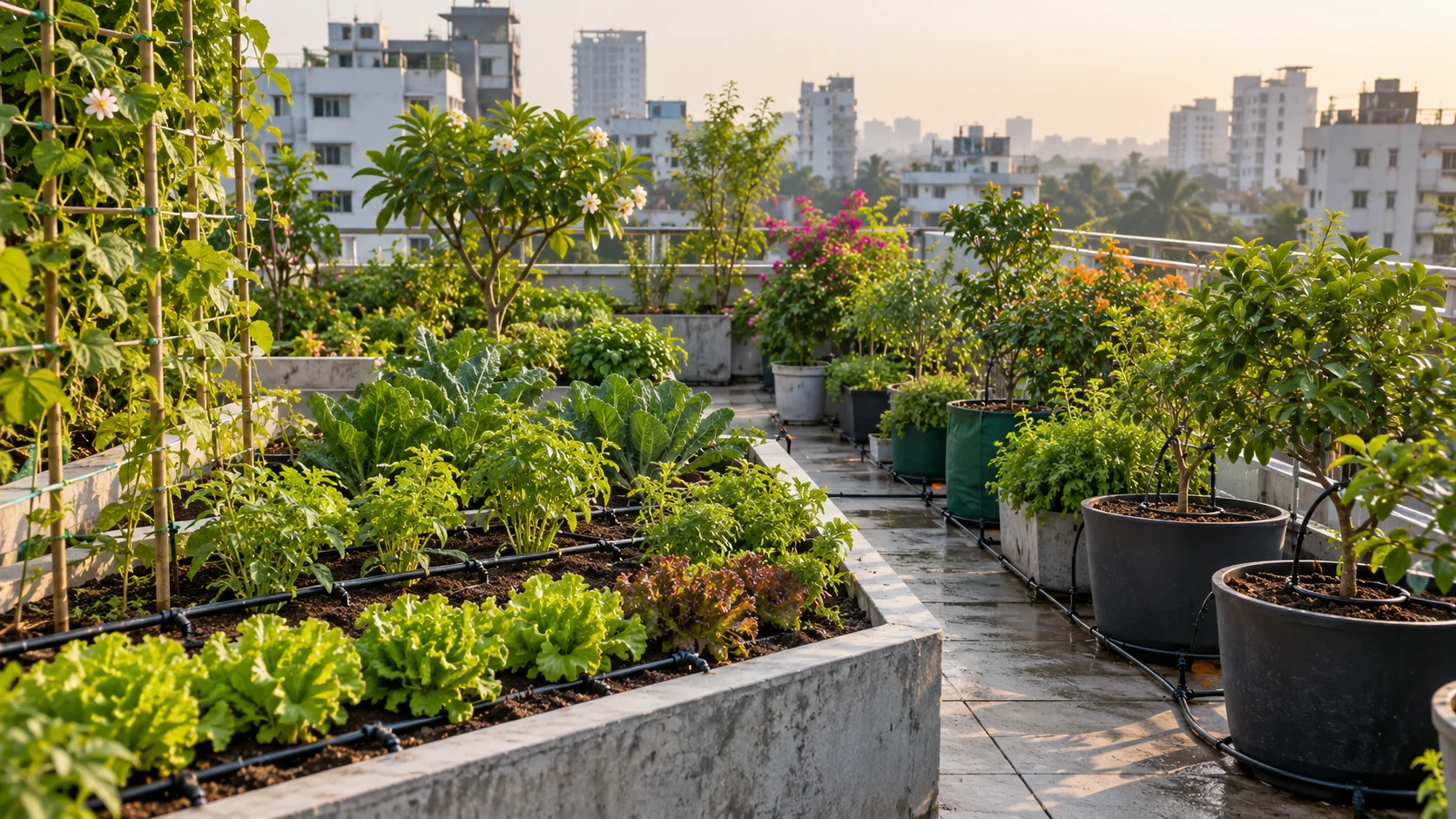
Drip Irrigation System for Rooftop and Landscape Gardens
A well-planned drip irrigation system delivers water through small tubes and emitters close to plant roots. For rooftop gardens and landscape beds, it can make watering more consistent and reduce the need to carry a hose between plants. The system still needs the right layout, clean water, suitable pressure and regular checks.
In Dhaka, a rooftop garden may face strong sun, wind, sudden rain and fast-drying containers, while a ground-level landscape has different soil and shade conditions. Design the irrigation around the actual plants and site instead of using one timer setting everywhere.
How drip irrigation works in a garden
Water moves from a source through a main supply line into smaller tubing. Emitters release it gradually at selected points near the plants. A simple arrangement may serve a few containers; a larger garden can use separate lines or controlled zones for different planting areas.
Unlike a spray pattern that wets a broad area, drip delivery concentrates water near intended root zones. That does not automatically make every installation efficient: blocked emitters, poor pressure, leaks or an unsuitable schedule can leave plants too dry or too wet.
Assess the rooftop or landscape before choosing parts
Map the garden and note each planter, bed, tree, tap, drain, walkway and shaded area. Group plants with similar watering needs and measure the tubing routes. Check that the water source can supply the system's required flow and that the line layout can be reached for inspection and repair.
For rooftops, keep tubing tidy and secured so it does not become a trip hazard or move in wind. Do not block roof drains, cover inspection points or attach equipment through a waterproofing layer without the responsible building professional's approval. Plan where any accidental overflow can go safely.
Emitter spacing and flow depend on plant size, growing medium and how water spreads through that soil. Utah State University Extension explains these design choices for backyard beds and shrubs in its backyard drip-irrigation guide.
Choose the right drip irrigation components
- Filter: traps particles that could block the small openings in emitters. Choose it for the water source and the irrigation components, then clean it as recommended.
- Pressure regulator: brings incoming pressure into the range specified for the selected tubing and emitters. Do not assume every kit uses the same pressure.
- Main line and lateral tubing: carry water from the source to each bed, planter row or container group. Use outdoor-rated materials suitable for the site's exposure.
- Emitters or dripline: release water at selected points. Use point-source emitters for spaced containers or shrubs and inline emitters where a continuous row of plants calls for them.
- Shutoff, flush ends and optional timer: make it easier to isolate a zone, clear debris from lines and automate a suitable routine. A timer does not replace inspection.
Emitter openings can clog because of suspended particles, mineral deposits or biological material. The UN Food and Agriculture Organization notes that filtration and maintenance are important to prevent clogging in localized irrigation systems; the filter type should match the water and equipment. See the FAO guidance on water quality and drip-system clogging.
Create watering zones for different plants
A rooftop may combine vegetables, herbs, flowering pots and larger fruit trees. Their root volumes and water needs are not identical. Put plants with broadly similar requirements on the same zone, and keep containers that dry quickly separate from beds that hold moisture longer.
Sun exposure matters too. A container on a hot, exposed roof can dry faster than a shaded planter just a few metres away. On a sloping landscape, elevation changes may affect delivery; appropriate pressure-compensating emitters or shorter zones can help when selected for the system's specifications.
For trees, place emitters where they wet the active root area rather than simply beside the trunk, and review the arrangement as the canopy grows. A system installed for young plants may need adjustment over time.
Set a schedule that responds to Dhaka weather
There is no reliable universal rule such as “run the system for ten minutes every day.” Water needs change with plant species, container size, growing medium, sunlight, temperature, wind and recent rainfall. Start with the equipment instructions, then check moisture in the root zone and observe how plants respond.
Watering early in the day is often practical, but skip or shorten a cycle after useful rain and reassess during hot, dry spells. In the monsoon, make sure pots and beds drain freely; an irrigation timer should not keep running as if no rain had fallen. Adjust one zone at a time and record the change so you can see its effect.
Maintain the system and spot problems early
- Run each zone and look for leaks, loose connectors, kinked tubing and emitters that are not delivering water.
- Inspect and clean the filter at an interval suited to the water quality and manufacturer's instructions.
- Flush line ends when needed to remove accumulated debris, following the system guidance.
- Check the soil rather than relying only on a timer; blocked emitters can leave a plant dry even while the controller is running.
- Reposition or add emitters as containers, shrubs and trees grow, and repair tubing damaged by foot traffic or weather.
If one plant wilts, compare its soil moisture with nearby plants and check its emitter before increasing the whole system's run time. Persistent clogging, uneven flow or leaks call for checking the water source, filter, pressure and line layout—not simply extending the timer.
When to get a professionally planned system
A small set of containers may suit a basic kit, but a larger rooftop or mixed landscape needs a closer look at water supply, zones, pressure, drainage, safe tubing routes and maintenance access. A site-specific design can help make sure the selected components work together and can be serviced after installation.
Baganbari provides rooftop gardening in Dhaka and can discuss irrigation as part of a wider garden plan. Explore our Drip Irrigation service or contact our team to discuss your rooftop or landscape, plant mix and water source.